Quantum Computing
Quantum Annealing
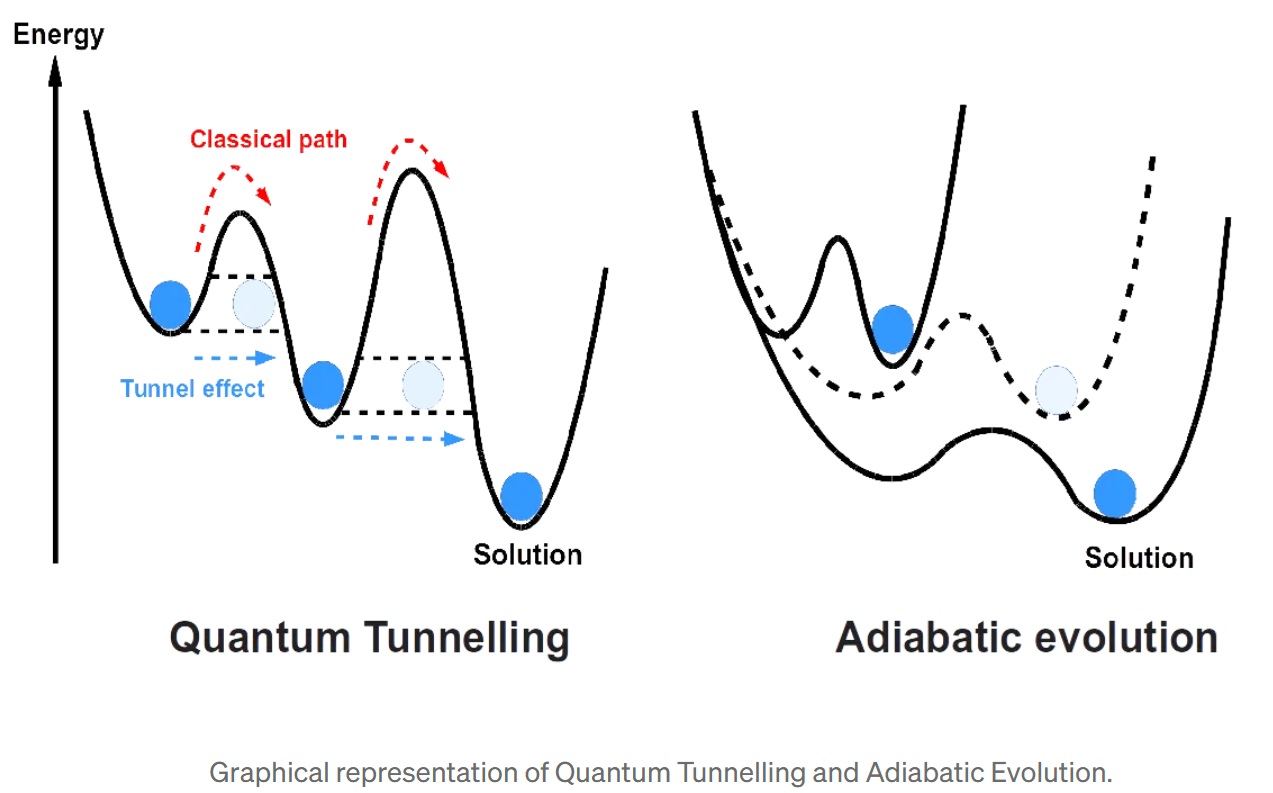
Quantum annealing is a computational optimization method that uses quantum mechanics phenomena to find the global minimum of an objective function in the solution space. This approach proves particularly useful in solving complex combinatorial problems characterized by numerous local minima.
Unlike classical simulated annealing, which involves gradually lowering a system's temperature to find the most favorable solution, quantum annealing relies on quantum tunneling. This phenomenon allows particles to pass through energy barriers rather than merely overcoming them. Consequently, it enables more efficient "bypassing" of local minima and faster attainment of optimal solutions.
Article: Ewald, D. Application of Quantum Computers and Their Unique Properties for Constrained Optimization in Engineering Problems: Welded Beam Design. Electronics 2025, 14, 1027.
Quantum cryptography

Quantum cryptography is a field of cryptography that leverages phenomena of quantum mechanics to provide the highest level of security in communication. Its primary goal is to create systems resilient to eavesdropping and attacks, including those that could be carried out using quantum computers.
Key Features and Principles:
- Heisenberg's Uncertainty Principle Measuring the state of a quantum particle (e.g., a photon) inevitably changes its state. This means that any attempt to eavesdrop on a transmission will be detected, as it will introduce disturbances in the transmitted data.
- Quantum Entanglement Two particles can be entangled in such a way that measuring one immediately determines the state of the other—regardless of distance. This phenomenon can be used to generate and distribute random, perfectly synchronized encryption keys.
- Quantum Key Distribution (QKD) This is the most important practical application of quantum cryptography. The most well-known QKD protocol is BB84, developed by Charles Bennett and Gilles Brassard in 1984. QKD enables the secure transmission of an encryption key between parties—even in the presence of an eavesdropper, whose presence will be detected.